

There are a lot of buzzwords in the design industry. We say things like timeless, unique, one-of-a-kind—or even trendy, which somehow seems to come with a slightly more negative connotation than the others.
But what does it actually mean to create a space that is unique or one-of-a-kind while still feeling timeless? Is that even possible?
The short answer is yes. But you have to be careful about how you do it.
And often, that means stepping away from Pinterest, Instagram, or wherever you typically find inspiration and looking at a few other things first.
Step One: Look at What Is Already There
Before you decide what you want to add, look at the space you actually have to design.
Look at the bones. The architecture. The empty room.
This applies to both interior design and wedding or event design. Before we start talking about colors, furniture, flowers, linens, or décor, we need to understand the space itself.
What does the architecture tell us? What materials are already present? What colors can’t—or shouldn’t—be changed? What is the history or character of the space?
Because regardless of what you bring in, the structure is still there.
Of course, you can completely gut a house, cover every surface, or transform a venue beyond recognition—but that’s a whole other can of worms.
Most of the time, good design starts by acknowledging what is already there rather than fighting against it.
Step Two: Look at What You Already Love
Now look at the things you know you love.
Maybe there’s a sofa you already own that you adore. Maybe it’s the shape, the color, the fabric, or simply the way it makes the room feel. Put that on the “keep” list.
There may also be pieces you don’t particularly love. They were inherited, handed down, purchased for another house, or simply ended up there somehow. We don’t have to build an entire room around those.
The important thing is identifying the pieces that actually mean something to you.
And they don’t necessarily have to match the architecture perfectly. That’s where the next step comes in.
The same thing applies to color.
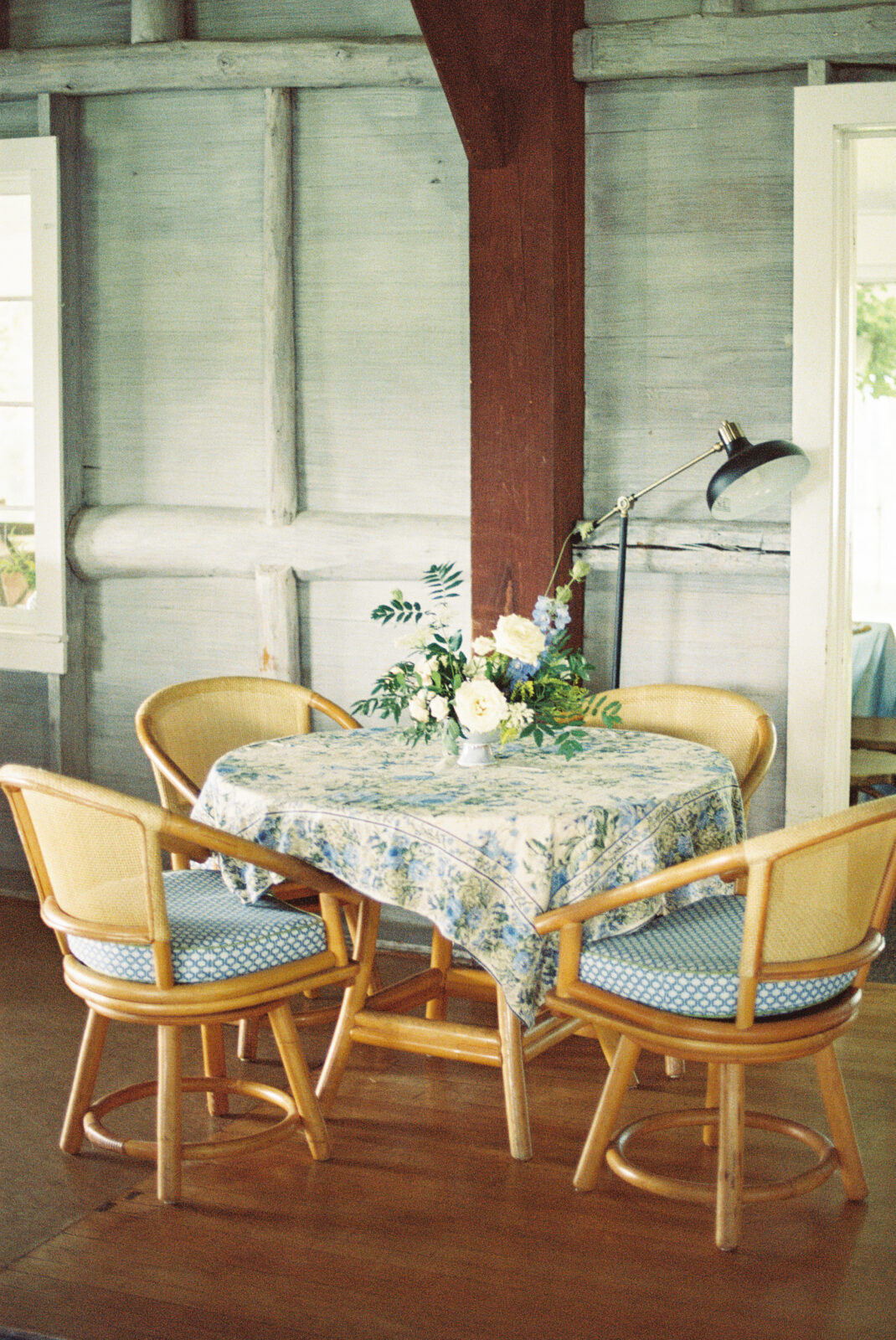
Maybe blue is your absolute favorite color and you can’t imagine designing a room—or your wedding—without it. But your house or venue already has a strong presence of red in the carpet, tile, brick, or another element you can’t change.
That doesn’t mean we throw blue out because we’re terrified the whole thing is going to look like the Fourth of July.
It simply means we have to figure out how to marry those two ideas together.
Step Three: Marry the Two
This is where I think design gets both tricky and really interesting.
We have a tendency to evaluate every element individually:
I don’t like those candlesticks.
I don’t like that coffee table.
I don’t like that wallpaper.
But stop looking at each piece as an individual item and look at the space as a whole.
You love the sofa. You love the blue. And whether you love every single detail of the house or venue or not, it’s the space we’re working with.
So now we find the pieces that bridge those things together.
If we have that red and blue combination, maybe we introduce a softer shade of red somewhere else. Maybe we bring in green, a different shade of blue, a warm neutral, or another color that rounds out the palette so suddenly it isn’t a “red and blue room” anymore.
It becomes a layered palette.
We’re no longer asking every individual piece to be perfect on its own. We’re asking it to contribute to the larger story.
So What Does Any of This Have to Do With Timeless Design?
After all of that, you might be thinking: Shelby, what does this have to do with creating something unique or timeless?
Everything.
Timeless spaces feel like they belong.
They’re built around the architecture and the bones of a space rather than forcing an unrelated style onto it.
Farmhouse design is a perfect example. Farmhouse elements can feel completely timeless in an actual farmhouse because they make sense within the context of the architecture. Put those exact same elements into a suburban house with entirely different architectural roots, and they can begin to feel dated—or even a little tacky—as soon as the trend passes.
The individual item wasn’t necessarily the problem.
The context was.
And that’s also where the “unique” part comes in.
Once you’ve honored the space itself, you start layering in the things you genuinely love—not the things you’re choosing because you saw them 37 times while scrolling Instagram this week.
Maybe it’s an antique that belonged to your grandmother. A slightly strange piece of art you fell in love with. A color you’ve adored your entire life. A fabric that reminds you of somewhere you’ve traveled. A piece of furniture that isn’t necessarily “on trend” but that you would buy again tomorrow.
Those choices give a space personality.
And when you choose something because you love it, rather than because Pinterest told you that you should, there’s a much better chance it will remain timeless to you.
Of course styles change. Our tastes evolve. And no room—or wedding, for that matter—is ever going to exist completely outside of the era in which it was designed.
But that’s okay.
The goal isn’t to create something that no one can date to a particular decade.
The goal is to create something that makes sense.
Honor the architecture. Pay attention to the context. Keep the things you genuinely love. Find the pieces that marry those worlds together.
Those are the bones of a design that feels personal, collected, and uniquely yours—and that’s about as timeless as you can get.




LEAVE A COMMENT
View Comments